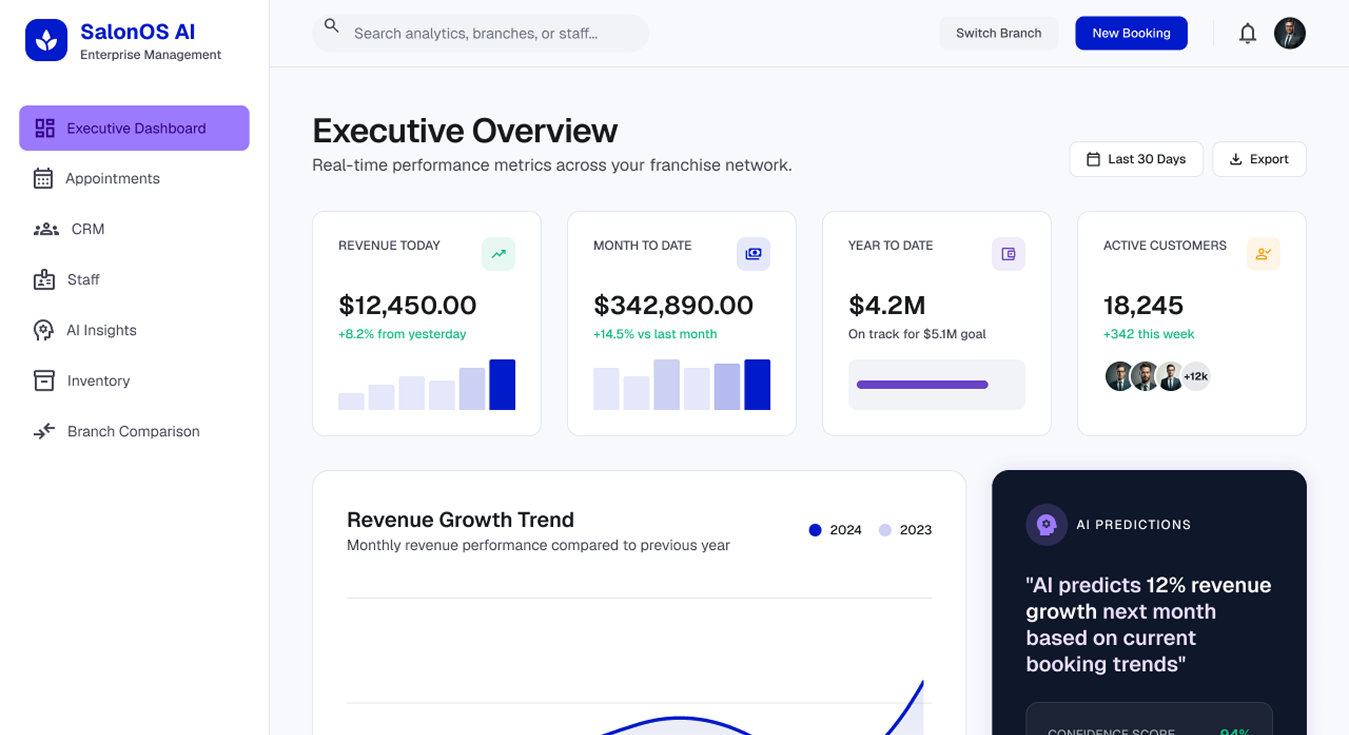
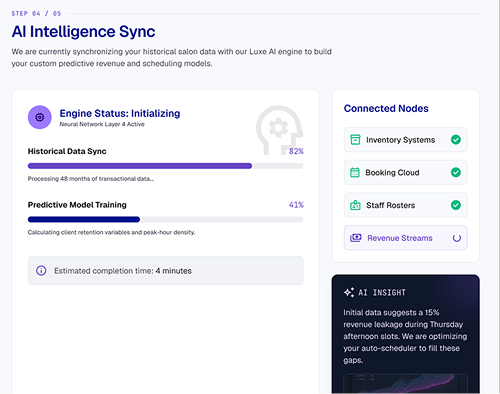
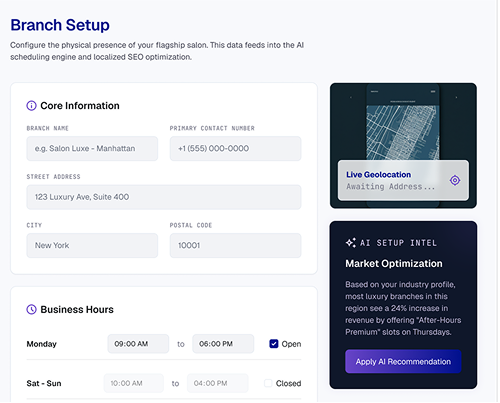
A concept-driven SaaS platform designed to help salon owners manage bookings, staff, customers, marketing, and AI-powered business insights in one unified workspace.
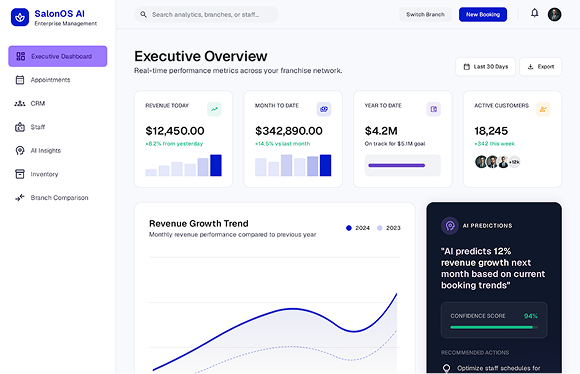
Salon owners juggle 4–6 disconnected tools daily — from paper appointment books to WhatsApp reminders to manual spreadsheets. SalonOS AI explores a unified platform that eliminates this friction.
Manual scheduling leads to double-bookings, missed slots and high no-show rates averaging 23%.
No upsell triggers, no loyalty tracking, and no insights into customer lifetime value or churn signals.
No visibility into stylist utilization, performance metrics or commission accuracy across the team.
Salon owners lack tools to run targeted re-engagement campaigns, seasonal promos or loyalty rewards.
How SalonOS AI positions against existing solutions in the market.
| Platform | AI Features | CRM | Marketing | Analytics | Price Point |
|---|---|---|---|---|---|
| SalonOS AI Ours | ✦ Full AI | ✦ | ✦ | ✦ | Mid–Premium |
| Vagaro | ◐ Limited | ✦ | ◐ | ◐ | Mid |
| Fresha | ○ None | ◐ | ✦ | ◐ | Free + Commission |
| Mindbody | ◐ Limited | ✦ | ✦ | ✦ | Premium |
| Booksy | ○ None | ◐ | ◐ | ○ | Low–Mid |
Two core archetypes drive every design decision in SalonOS AI.
Mahirah S, 22 · Owns 2 salon locations in California
"I spend 3 hours every morning handling bookings, checking WhatsApp messages, and chasing payments. I need to run my business, not manage tools."
Jessica, 28 · Marketing professional in Boston
"I want to book my stylist in 30 seconds on my phone, get a reminder, and know my visit history is saved for next time. That's all I ask."
Mapping emotional touchpoints from first discovery to loyal return visits.
Mapping business outcomes to product solutions through structured discovery.
Features ranked by Reach × Impact × Confidence ÷ Effort, then sequenced into build phases.
Every AI touchpoint follows a responsible design loop — not black-box automation.
Predicts next booking time based on client history, suggests optimal stylist pairing, and auto-fills gaps in schedule.
Analyzes customer visit patterns and suggests add-on services at checkout with personalized copy and timing.
Detects dormant customers after 30 days, triggers personalized re-engagement SMS with discount offer, and tracks conversion.
High-fidelity wireframe representations of key product screens and workflows.
As a concept case study, the metrics below represent post-launch success criteria and target outcomes rather than actual measured results.
What this project demonstrates and what comes next.
From problem discovery through OST, user research, journey mapping and IA — this case study demonstrates a full product design lifecycle, not just UI outputs.
Every AI touchpoint follows a human-in-the-loop framework. Automation is never blind — owners retain control over consequential decisions, building trust in the system.
Token-based colors, radius, spacing and typography create a system that scales from a single salon to an enterprise multi-location chain without visual debt.
Conduct moderated usability testing with 5–8 salon owners, run A/B tests on the booking flow, validate AI feature adoption, and track real-world KPI performance.
Salon owners do not need more features. They need fewer manual tasks and better operational visibility.
Reducing no-shows and improving retention creates more business value than simply increasing new customer acquisition.
AI should simplify workflows, automate repetitive actions, and support decisions rather than replace human expertise.
How key features translate into user and business outcomes
| Feature | User Impact | Business Impact |
|---|---|---|
| AI Reminder System | Fewer missed appointments | Revenue Growth |
| Loyalty Engine | More repeat visits | Higher Customer Lifetime Value |
| Automation Tools | Improved staff efficiency | Operational Savings |